
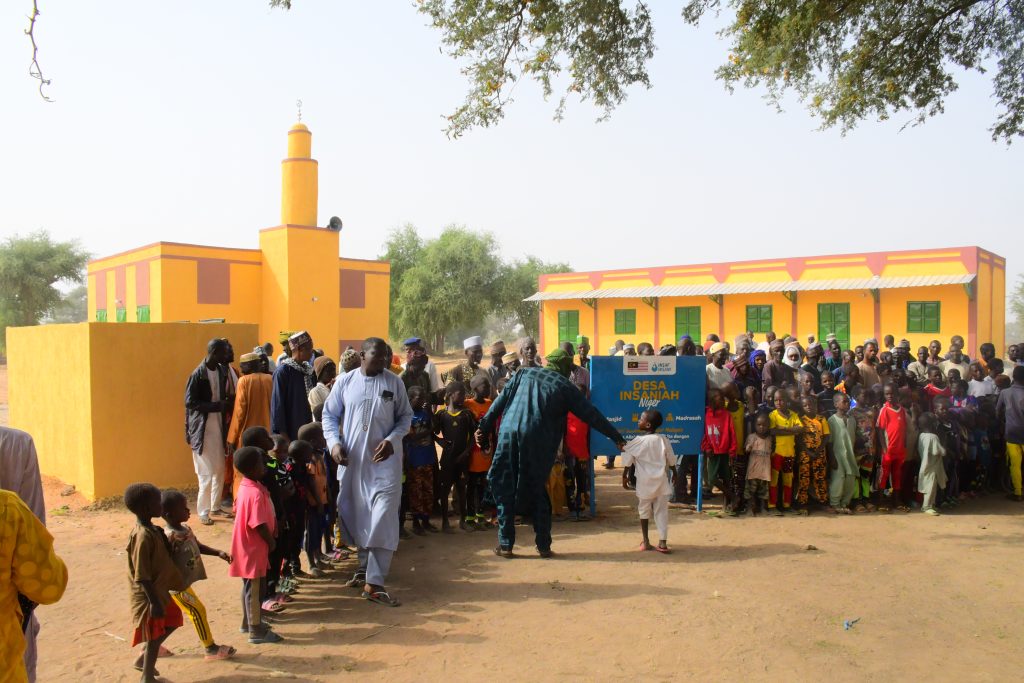
Zangon Jāw, Madawā, Tahoua | January 19, 2026 — In the Sahel region of Africa, the lack of basic infrastructure remains one of the primary development challenges, particularly in rural communities facing structural poverty, climate pressure, and limited access to public services. In this context, Pertubuhan Insaf Insani Sejagat has implemented a community development initiative encompassing the construction of a mosque, a madrasah, and a manual well in the village of Zangon Jāw, Madawā, in the Tahoua Region of Niger.
This project targets the fundamental needs of a local community often marginalized from mainstream development, specifically focusing on worship facilities, religious education, and access to clean water —three vital components for long-term social stability.
Basic Development as a Mechanism for Community Resilience
In total, approximately 600 beneficiaries, including the poor and madrasah students, are directly benefiting from this project. In the Tahoua region, which frequently faces drought and water scarcity, the construction of a manual well is more than just a utility; it is a survival mechanism that reduces health risks and the daily burdens of the residents.
The construction of the mosque began on November 14 2025, followed by the construction of the madrasah on November 16 2025, and the manual well project on November 17 2025. All project components were successfully completed by January 18 2025, reflecting organized and focused implementation planning.
Education, Water, and Worship in the Sahel Geopolitical Landscape
According to the implementing representative, the existence of the new mosque and madrasah provides a more comfortable and safe space for the community to perform worship and carry out religious learning activities. In the Sahel context, community educational institutions function as a social fortress — helping to build literacy, values, and community resilience in an environment exposed to economic and security instability.
At the same time, the construction of the manual well increases access to clean water supplies, thereby contributing to the improvement of public health and community productivity. In modern humanitarian analysis, access to clean water in the Sub-Saharan African region is seen as a strategic factor directly linked to social stability and long-term development.
From Humanitarian Aid to Impactful Development
This initiative reflects a shift from short-term humanitarian aid to impactful community development, in line with the needs of a region requiring sustainable solutions, not just emergency responses. The role of humanitarian organizations such as Pertubuhan Insaf Insani Sejagat is becoming increasingly significant in filling implementation gaps in areas facing institutional capacity constraints.
This effort is hoped to improve the quality of life of the local community and provide long-term benefits to future generations — especially in building the foundations of education, health, and social harmony.
Public Funding as an Impact Catalyst
In a global reality witnessing a widening development gap, public support plays an important role in ensuring community-scale projects can be realized consistently. Through Seedkind.my, the public has the opportunity to be part of this chain of trust — turning concern into real action.
Every contribution at Seedkind.my functions as an impact catalyst: small in value, big in effect. In a world often trapped in large-scale geopolitical discourse, public funding proves that meaningful change can also start from collective action that is directed and trustworthy.